What makes a bathroom safer for people with limited mobility?
My sister fell in her bathroom from standing height while reaching for a towel on a Tuesday morning. The result was three weeks in hospital followed by two grueling months of physical rehabilitation.
That has to stop! The fall my neighbor suffered in her bathroom a few weeks ago was entirely avoidable and she’s now lost 3 weeks of her life in hospital and spent 2 months of grueling rehab in order to try and recover from her injury. All this as a result of slipping on a wet floor and losing her balance for a split second, whilst reaching down to pick up a towel. I’m very worried as her bathroom is almost identical to our own. The problems with her bathroom have made me realize just how full of potential hazards a normal bathroom can hold for the older and less mobile person and what can be done to try and avoid these problems.
So, beyond the simple reading of a checklist, what changes are needed to bring the risk of falls in bathrooms down to a safe level? A discussion of space, of risk, and of choices, some simple, some more complex, and open to interpretation.
The floor is doing more harm than you think
Wet tiles are often the biggest cause of slips and falls in bathrooms. People perceive wet tiles to be no problem even though they are very slippery. Many people are surprised when they slip on a wet floor even though they were previously walking on the very same area.
There are many mats on the market with non-slip surfaces. Ensure that the mat that you choose does not curl up at the edges as this will become another tripping hazard. Opt for a mat with good suction to the floor and replace when it starts to come unstuck from the floor. Within the shower or bathroom area non-slip strips or textured mats can be of great assistance. These are ideal for individuals with mobility problems and are unstable when entering or exiting the shower or bath.
Some people choose to replace the smooth face of tiles with a textured or matte finished tile. This is a very expensive modification to make especially when it is part of a larger bathroom renovation. However it is worth speaking with your contractor about the option as part of your bathroom design.
Grab rails: not just for hospitals
Much debate and discussion has gone on as to whether grab rails should be fitted in bathrooms. There is an inherent stigma attached to using grab rails as they are perceived to signify weakness and possibly indicate that the person is elderly or declining. However, in actual fact, grab rails are simple aids that have been developed for various situations and are most commonly used in the bathroom. Grab rails are easily fitted into place to act as another piece of bathroom equipment to assist people in various situations. Just as a racing driver would wear a seatbelt for his own safety, a grab rail can be fitted in the bathroom to act as the bathroom’s seatbelt and to prevent a fall.
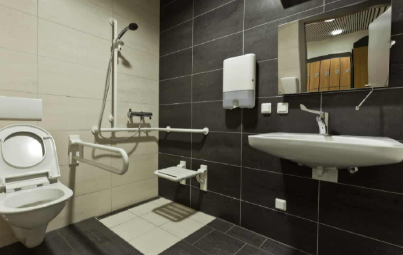
Grab rails can be installed in a number of locations in a bathroom to help support people to complete tasks without falling. The most common locations for grab rails are next to the toilet, along the shower wall or near the bathtub. Careful consideration must be given to the location of the grab rail as it is possible for the rail to pull the user off balance if installed in the wrong location. To maximize their effectiveness grab rails should be installed in locations where they can offer the most support.
- Next to the toilet, on the dominant-hand side, to assist with sitting down and standing up
- Inside the shower, at about hip height, for stability while washing
- Near the bath edge, to support the transition in and out
- On the wall adjacent to any step or raised threshold
Wall-mounted grab rails MUST be fixed into studs, if that is not possible then suitable anchoring hardware should be used. A grab rail that has been poorly anchored is worse than having no grab rail at all, as it gives false confidence until it fails.
Fatigue While Showering
Another thing that’s very tiring is standing in the shower. Most people can’t stand for the whole time they are in the shower, even if they don’t have any mobility problems. This is especially true for people who are tired, dizzy, recovering from an operation or are having a terrible week.
Most people are unaware that being able to sit down in their shower could remove an entire category of risk for falls. Providing a good quality shower chair is an inexpensive and very effective method of removing risk of falls. It is very important to look for a few simple features: 1) a weight capacity for the user, 2) non-slip feet for the legs of the chair to sit on, and 3) height adjustability to ensure the seat of the chair is at the correct height for the user. There are many styles of shower chairs to choose from, some models are designed to fold up against the wall of the shower when not in use, while others are free standing and can be moved from place to place as needed.
The biggest Fall Prevention Strategy for the bathroom is likely to be low cost, low effort, very high impact. We so commonly talk about expensive bathroom renovations that it’s surprising how much can be gained with the simplest of tools such as a shower chair (see below).
Comparison of changes required to bathrooms in terms of required effort and impact.
| Modification | Effort to install | Cost range | Impact on safety |
| Non-slip floor mats | Very low | Low | High |
| Grab rails | Moderate | Low to moderate | Very high |
| Shower chair | Very low | Low | High |
| Night lighting | Very low | Very low | Moderate to high |
| Tile replacement | High | High | High |
As for the modifications, there are many alterations that can be done to a bathroom in order to assist mobility impaired individuals. But, all of the modifications can be done at different levels, such as low cost or high effort, in order to better fit the budget of the person doing the alterations. In the following table, many of the common modifications have been added to two categories: Effort and Impact. Modifications have been ranked from lowest to highest in both Effort and Impact. Looking at the modifications in the table, the modifications that have the highest impact are found in the modifications with the lowest Effort and lowest Cost. Therefore, for the majority of bathroom modifications, the highest amount of assistance for mobility impaired individuals can be created with minimal effort and cost.
The 2am problem
As stated before, falls in the bathroom can occur at any time of the day or night. However, the majority of falls do occur at night due to poor lighting. Most overhead lights are too harsh and take some time for the eyes to adjust to the light. A simple motion-activated floor light would suffice to light a person’s way. These types of lights are inexpensive, quiet and can be plugged directly into a wall outlet. Therefore, there is no excuse for not placing a night light in every bathroom in the house.
See also: theoperatormagazine
One thing people consistently underestimate
Clutter. Many falls have occurred because of items thoughtlessly left on the floor that were thought to be of no consequence. As with many things, until it becomes a disaster, no one considers it a problem. The bathroom, with all of its items, is perhaps the biggest falls in the home due to clutter. Half full bottles along the edge of the tub. A cluttered vanity with all of the various bottles and jars. A vanity stool left out and is just the right height to be kicked by someone stumbling. A laundry basket left on the floor, wedged between a door and a cabinet. The list of possible items that could cause a fall in a bathroom is endless. But removing the obstacles in a room is one of the easiest modifications to complete. Clearing the
Reduce Fall Risk by Removing Obstacles to Falls in the Bathroom- Clutter- Clutter can cause falls. It is well established that there are many modifications that can be done to a bathroom in order to make it safe for people to use. Many of these modifications are very inexpensive and can be done in a very short period of time. One of the modifications is to reduce the number of obstacles to falls in the bathroom by removing clutter. There are many items in a typical bathroom that can be stacked up such as bottles, packages, etc. These items take up a lot of space in the bathroom and can cause a very dangerous environment for people to trip and fall. By simply removing half of the items in the bathroom, a person can save themselves from having a very serious fall. A fall in the bathroom can occur at any time but is more likely to occur at night when it is dark. A simple example of an item that can cause a fall in the bathroom is a bottle of soap that is placed on the edge of a tub. This one item could cause a person to have a very serious fall. A simple act of removing half of the items in the bathroom could save a person from having a very serious fall. A person simply needs to take the time to look around the bathroom and remove some of the items that could cause a fall.
My neighbor would probably have said something similar to this the morning of that Tuesday.