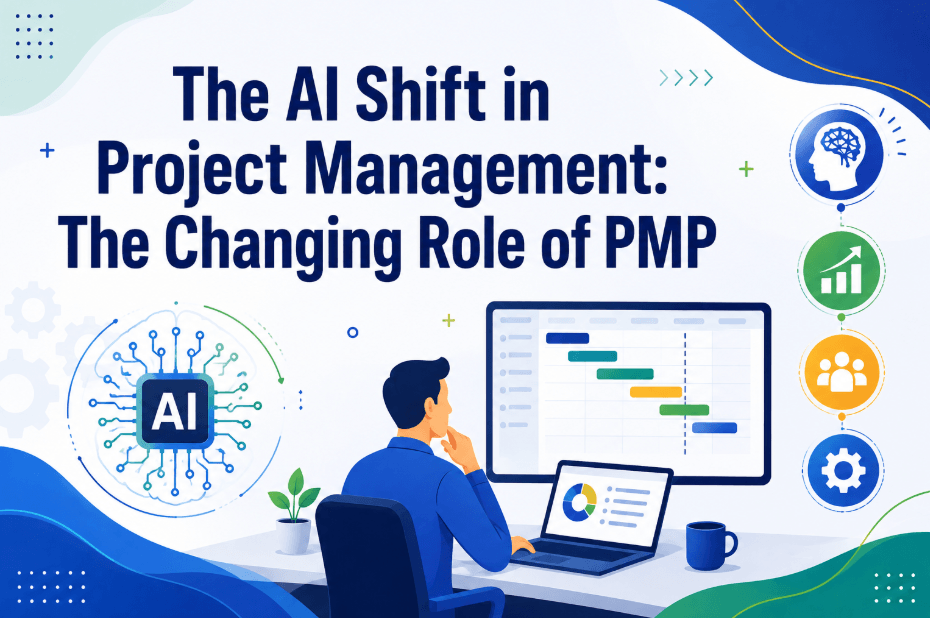
The AI Shift in Project Management: The Changing Role of PMP
What happens when Artificial Intelligence starts handling work that once took Project Managers hours to complete? Project management is entering a new phase where technology supports planning, analysis and everyday decisions. PMP Courses help professionals strengthen the skills required to work confidently in this changing environment.
At the same time, AI in Project Management is influencing how PMP professionals manage risks, resources and teams. Their responsibilities are becoming more strategic and people focused. This shift is also changing the skills and judgement Project Managers need to deliver successful outcomes. In this blog, we will explore the changing role of PMP professionals in the age of AI.
The Changing Role of PMP Professionals in the Age of AI
Below are the key changing roles showing the impact of Artificial Intelligence in Project Management on the responsibilities and work of PMP professionals:
Manual Planning to AI-Assisted Planning
Managers used to have to manually examine timelines, expenses, resources, and dependencies as part of project planning. AI can now evaluate past project data and offer helpful planning recommendations.
Because of this, PMP specialists are switching from manually creating every planning element to evaluating and refining plans created by AI. Their expertise is still crucial for ensuring that suggestions align with project needs. Professionals can improve the planning abilities required to make these well-informed choices by taking PMP Courses.
Data Collection to Data-Driven Decision Making
Project Managers frequently deal with a lot of data. In the past, gathering information from reports, meetings, and project systems took up a large portion of their time.
AI is able to swiftly process this data and identify helpful patterns. This allows PMP professionals to focus more on making informed decisions based on reliable data. Their duties now include analysing insights and determining how to apply them to the project. When weighing data against corporate priorities, human judgement is still crucial.
Reactive Risk Management to Predictive Risk Management
The identification of risks through evaluations, discussions, and professional experience is a common focus of traditional project risk management. Project Managers can detect potential issues much sooner thanks to AI.
AI tools can analyse patterns that may indicate potential delays, cost increases and resource issues. After that, PMP specialists can evaluate these alerts and take preventative measures. They are taking on a more proactive role, paying more attention to issues before they have an impact on project completion.
Routine Administration to Higher Value Work
It can take a lot of time to prepare reports, update task records, and organise project information. Many of these tedious tasks can be automated by AI, which also speeds up project updates.
PMP specialists can now devote less time to regular administration thanks to this modification. They can devote more of their attention to problem-solving, stakeholder communication, and team support. As a result, project management automation is transferring its contribution to tasks requiring human contact, judgement, and expertise.
Manual Resource Allocation to Intelligent Resource Management
Managing resources entails striking a balance between project deadlines, team skills, workloads, and availability. AI is able to evaluate these variables and recommend appropriate resource distribution.
As a result, PMP specialists are shifting away from depending solely on manual evaluations. They now have to evaluate AI advice and take human aspects into account. Before making decisions, Project Managers must still comprehend team capabilities, shifting priorities, and individual workloads in order to manage resources effectively.
Project Coordination to Strategic Leadership
AI can handle more analytical and administrative tasks, freeing up Project Managers to concentrate on leadership. It is becoming more and more expected of PMP experts to link project activities to broader corporate objectives.
Because of this, strategic leadership is crucial to their evolving function. They must manage stakeholder expectations, lead teams, and guarantee that initiatives continue to produce corporate value. Professionals can build the management and leadership skills necessary for these duties with the help of PMP Courses.
Using Tools to Collaborate with AI
AI is becoming more than just a tool for project management. Forecasting, planning, reporting, and decision-making are now supported. As a result, Project Managers and technology have a more cooperative relationship.
PMPs need to know which tasks require human judgement and which can be assisted by AI. While Project Managers offer context, communication, and expertise, strong human-AI collaboration enables technology to handle complex data. This equilibrium may facilitate more efficient project completion.
See also: Exterior Building Signage: How It Improves Business Visibility
Traditional Skills to AI-Ready Capabilities
While still valuable, traditional project management techniques are no longer sufficient on their own. It is becoming more and more important for PMP professionals to comprehend how AI tools facilitate project activities.
They should be able to evaluate AI results, identify false information, and use project data appropriately. It is not necessary to become an expert in technology to develop AI skills for Project Managers. Instead, experts must possess sufficient knowledge to securely employ AI while retaining authority over crucial project choices.
Task Supervision to People-Focused Leadership
Managing people becomes an even bigger part of the PMP professional’s job as AI takes over more repetitive tasks. Technology can assess project performance, but it cannot take the place of motivation, trust, or deep dialogue.
PMP specialists are required to assist teams in adjusting to new technologies and to handle concerns regarding these changes. Employee understanding of how AI enhances their work can be facilitated by effective communication and team leadership. As a result, the human aspect of project management becomes more and more important.
Conclusion
AI is shifting PMP professionals from routine coordination towards strategic thinking, informed decisions and stronger leadership. Understanding AI in Project Management can help professionals use technology without losing the value of human judgement. PMP Courses can strengthen the skills required to adapt to these changing responsibilities.
Professionals seeking relevant capabilities can learn with the top training provider, The Knowledge Academy, through PMP Courses that support the evolving demands of modern project management.