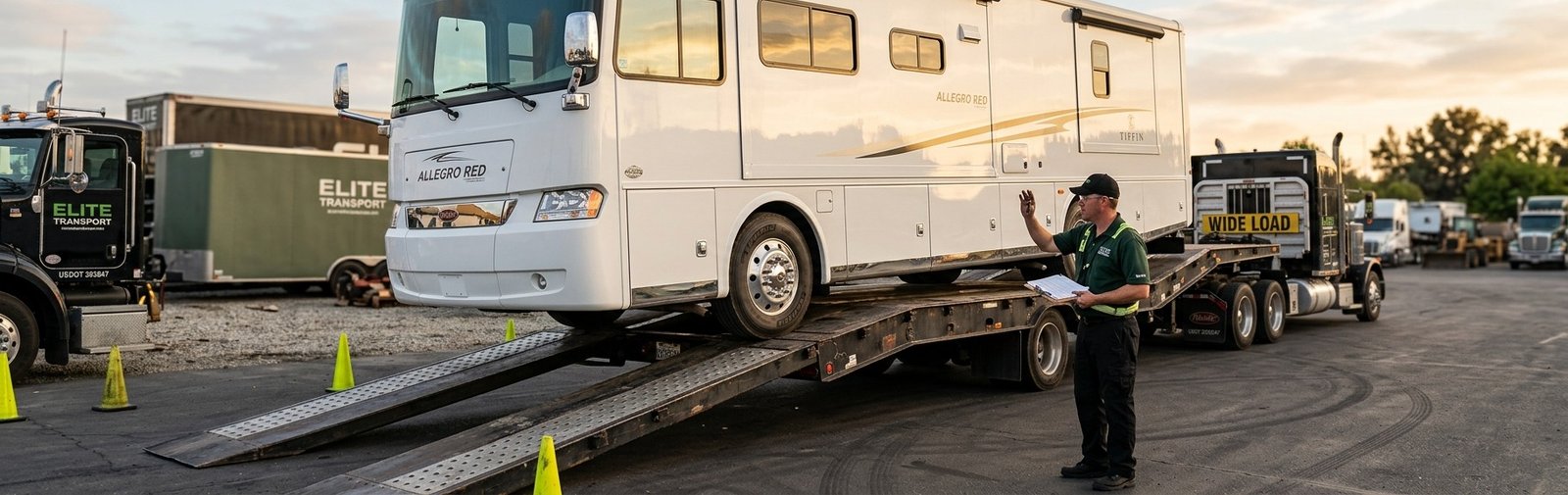
What RV Transport Companies Actually Do (And When You Need One)
Strip away the jargon and the service is simple. A transport company shows up, secures your RV, hauls or drives it to the destination, and hands you the keys. Some own the trucks. Some arrange a truck for you. More on that split later.
The umbrella term you will see is rv relocation services, and it covers everything from a cross-town move to a coast-to-coast haul.
Here is who actually books this:
- People relocating for a job or school who cannot caravan two vehicles at once
- Snowbirds shuttling a rig between summer and winter bases
- Buyers picking up an RV from an out-of-state dealer, auction, or private seller
- Seniors and first-timers who are not comfortable piloting an oversize vehicle
- Owners of a non-running or half-finished project RV that cannot move on its own
The size reality is the reason all of this exists. Many Class A motorhomes run 30 to 45 feet and weigh 15,000 to 30,000 pounds. That pushes them straight into oversize-load territory in most states. Snowbirds running a rig from Florida up north, or the reverse, deal with this every season, which is why seasonal car relocation exists as its own service.
How Much RV Transport Costs (Per Mile And By Rig Type)
This is the question everyone opens the tab for. So let us give you real ranges, with sources, not a shrug.
RV Transport Cost Per Mile Explained
The rv transport cost per mile moves with distance, size, weight, height, method, and season. The rule of thumb is boring but true. Short moves cost more per mile. Long moves cost less per mile.
Industry pricing for 2026 puts the average around $3 per mile, ranging from roughly $1.50 to $6 depending on the rig. Method matters just as much. A drive-away with a professional driver tends to run $1 to $2 per mile. Flatbed or tow hauling, where the RV rides on a carrier and adds zero miles to the odometer, runs closer to $2 to $4 per mile.
Quick answer: Shipping an RV in 2026 averages about $3 per mile. A 1,500-mile move commonly lands between $2,500 and $4,000, while a Class A on the same route can reach $8,000.
For cross country rv shipping cost, the spread is wide because rig type drives it. That is the next piece.
See also: Industrial Gas Turbine Technology: Powering Modern Industry with Efficiency and Reliability
Cost By RV Class And Trailer Type
A pop-up camper and a diesel pusher are not the same job, and the price says so. The class a motorhome transport cost sits at the top. The travel trailer shipping cost sits near the bottom. Enclosed rv transport cost runs higher still, and most people only pay for it on high-value or vintage rigs.
| RV Type | Typical Length / Weight | Est. Cost Per Mile | Notes On Method |
| Pop-Up / Small Camper | Under 20 ft / 1,500–4,000 lbs | $1.00–$2.00 | Usually towed |
| Travel Trailer | 20–35 ft / 5,000–11,000 lbs | $1.50–$3.50 | Tow-away is standard |
| 5th Wheel | 25–40 ft / 7,000–20,000 lbs | $2.00–$3.00 | Needs gooseneck hitch |
| Class C Motorhome | 20–33 ft / 10,000–13,000 lbs | $2.00–$4.00 | Drive-away or haul |
| Class A Motorhome | 30–45 ft / 15,000–30,000 lbs | $4.00–$6.00 | Drive-away common |
These are 2026 ballpark figures pulled from current RV transport rate guides. Your quote will shift with route and season.
Weight and dimensions drive the bill more than most owners expect. If you want the mechanics behind that, this breakdown of how vehicle size and weight impact shipping cost is worth the read. And if you are torn on protection level, the open versus enclosed cost comparison lays out when the upgrade is worth it.
Most rigs ship on standard open car shipping style carriers or open flatbeds, which keeps the price sane.
Ways To Move An RV Without Driving It Yourself
C:\Users\iamka\OneDrive\Desktop\TV AI Images\Ways To Move An RV Without Driving It Yourself
If you searched how to transport an RV without driving it, this is your section. There are three real ways to do it, and picking the right one is mostly about your rig.
Drive-Away Service
An RV drive-away service sends a licensed, insured driver to your door. They climb into your motorhome and drive it to the destination under its own power. This is the go-to for running Class A and Class C coaches.
The upside is cost. Drive-away is often the cheapest route for a drivable rig, since nobody needs a giant trailer. The honest trade-off is simple. Those miles and that engine wear land on your RV, not a carrier’s deck. For an owner who cannot or would rather not drive, an RV driveaway service turns a dreaded three-day trip into a phone call. That is a real relief for seniors or first-time owners, which is exactly what senior-friendly auto shipping is built around.
Tow-Away And Flatbed Hauling
Tow-away hitches the RV behind a truck and pulls it. This is the standard play for a travel trailer or a 5th wheel, and it keeps the travel trailer shipping cost reasonable.
Flatbed and step-deck hauling loads the RV onto a carrier so it never rolls on its own tires. This is the route for anything non-running, low-clearance, vintage, or fragile.
Quick decision guide:
- Drivable motorhome on a tight budget, go drive-away
- Travel trailer or 5th wheel, go tow-away
- Non-running, vintage, or low-clearance, go flatbed